Saturday, December 31, 2022

Everything Everywhere All at Once (2022)


Everything Everywhere All at Once (2022)

Director: Daniels

Stars: Michelle Yeoh, Ke Huy Quan, Stephanie Tsu, James Hong, Jamie Lee Curtis


Short Review, no spoilers

Even as it draws on diverse multiple influences, Everything Everywhere All at Once was a breath of fresh air on its cinema release, a blast-off out of Covid and general world-weary fatigue with an exuberant challenge to the Marvel movie factory output and stay-at-home-forever streaming services. Michelle Yeoh and Jamie Lee Curtis are both versatile by simultaneously dowdying it up and kicking ass in an all-round display of excellent performances, which also feature a welcome return to the big screen in both treasured 1980s childhood icon Ke Huy Quan and legendary Chinese Hollywood actor James Hong, as well as an assured turn from the next generation in Stephanie Tsu. A wonderfully entertaining and wry tribute to Chinese-American relations - in everyday life as well as popular film – the Daniels provided an exhilarating mix of the bizarre and the ordinary that resilient cinemagoers could see under persistently restrictive circumstances.


Full Review (spoilers)

A heroine in the form of a Chinese-born American laundromat owner is brought to the forefront of Daniels’ story - and movie-watchers consciousness - in this noisy and apparently chaotic blur of sci-fi existentialism, action and comedy. Through the knockabout spectacle of a Jackie Chan movie double-energised by rapid-cut editing and flashy visuals, the Daniels address an underrepresented community with contemporary dynamism, as if to say – ‘Yeah, you know all that martial arts stuff you love so much Hollywood, that elegant violence you’ve capitalised on over the decades and continue to utilise? From the same culture that started out in America washing shirts for Gold Rushers in the 19th century.’* Except here the Wangs are the stars of the show in both their glorious ordinariness and their ass-kicking alternate identities. It’s a unique approach, drawing on the enduring popularity of martial arts in film while simultaneously tempering the exoticisation of East Asian characters by promoting working-class strugglers to the forefront, something that appears to be having a significant moment, most noticeably in South Korean cinema with films like Parasite and Shoplifters. The latter two carry universal messages for other divided societies also, but here is a heartfelt tribute to a more specific experience of generational Chinese immigration in America, acknowledging light-heartedly but also pointedly some of the tensions that arise between the exchanged flow of various distinct cultural values. It begins with language, the film opening with a Cantonese conversation speckled with English between spouses Evelyn and Waymond Wang (Michelle Yeoh, Ke Huy Quan); later, Evelyn’s elderly father Gong Gong’s (James Wong) criticism of his granddaughter, the American brought up Joy (Stephanie Tsu) for speaking worse Chinese every time he converses with her; and Evelyn’s protestations that her reference to Joy’s girlfriend as ‘him’ is a faux pas in English but irrelevant in Chinese as him and her is the same word.

Ke Huy Quan’s return to the big screen is a joy to behold for fans, a middle-aged man now but still displaying the same energy, enthusiasm and physicality as he did playing Short Round and Data, an earnestness that is a significant part of an intriguing mix of old school action movie performance and the ‘whatever’ postmodern irony displayed by Waymond’s millennial era daughter, Joy. In this spin cycle of old and new and Asian/American cultural crossovers, the film combines the light-hearted approach to action of the afore-mentioned Jackie Chan movies with the more recent shift to adult humour in Hollywood movies like Deadpool, the latter a part of a shift that has rescued superhero movies from the dry, imperious drudgery of the Serious Phase kick-started by the crushingly boring critical darling that was Dark Knight. Reminding us that action movies are supposed to be fun, what the Daniels also pull off here in unique and successful fashion is a serious talent for silly, amping rudeness to the max when Joy uses a massive double dildo in her mighty-morphing fight scene with Evelyn, and peaking with a wildly hilarious scene involving Deirdre’s tax auditor of the year award and some very determined ass antics.

The most explicit reference to other movies however is one that involves Ratatouille of all things, as Evelyn’s endearingly mumsy mispronunciation and misrecognition unexpectedly subverts the more obvious comparison she appears to be trying to make between her situation and The Matrix during an urgent attempt to explain it to Waymond and Joy. It gives birth to a hilariously nonsensical running gag and yet more surprising poignancy, much like a sequence that involves a bizarre relationship fantasy between versions of Evelyn and Deirdre who inexplicably have hot dogs for fingers. And less weird but as romantic is a tribute to the Asian arthouse excellence of the 1990s in sequences featuring Evelyn and Waymond re-enacting In The Mood for Love, with Ke Huy Quan making a surprisingly dashing Andy Cheung.

At the heart of the film, underneath all the flash and bang, chaotic visuals and elaborate sci-fi universe-jumping twaddle is a simple story, reflecting a very real human tendency to overcomplicate. What this wild and sprawling existential crisis can be boiled down to is that Evelyn needs to appreciate her silly husband more and get over her daughter’s gayness. There are a few other things too, like not caring about her father’s disapproval and finding ways to negotiate with their auditor, although there maybe should be a disclaimer of ‘Please don’t try this at home’ should anyone think convincing yourself you love your auditor will necessarily save your home and livelihood. Of course, forgiving this hilarious and welcome unrealism is as necessary as the forgiveness of mess, as Evelyn tells her daughter in her ultimate moment of self-realisation. It deals with regret in a pleasingly ambivalent way - glimpses of life as an opera singer or glamorous martial arts star are not delivered with patronising disclaimers of the downsides of fame and wealth, and when ‘In the Mood for Love’ Waymond tells ‘Maggie Cheung’ Evelyn that he wished he’d had the life with their daughter and dealing with tax audits, there is no response either way from Evelyn. Disillusionment is made funny when Evelyn is desperate to tell Waymond she has just discovered that her life would have been better without him like an astonished and eager child who has found the door to a secret garden. Likewise, when Alpha Waymond tells her earnestly that out of all of the Evelyns across parallel universes, she is remarkable for the one that is living her worst life is a nice twist on the contemporarily popular phrase.

The black hole/bagel can be read as a symbol both of depression and of the emptiness of modern existence, and is exemplary of the film’s compelling mix of puerility and pathos. Joy’s frequently changing and increasingly outrageous costumes speak of the desperate identity-seeking of the millennial in a world threatening to sink her in to bland oblivion – underneath the showy façade is a black hole, inviting the viewer to look more closely at the power and potential, the seemingly endless possibilities and ease of transformation apparently available to the youth of today, but that really just covers over the risk of falling in to despair if not interrogated.

As an example of cultural diversity, Everything Everywhere All at Once comes from a genuine place, and does what all good art should do by throwing up challenges to dominant discourses rather than merely inserting non-white peoples in to artificially created scenarios. By referencing Chinese presence in the USA both through the laundromat that was established in the earliest stages of building America, as well as the martial arts that continue to inform action choreography in movies, Daniels’ offer a clever and distinct challenge to the mainstream. Also, it is a chatty dialogue rather than a pedagogical speech running throughout the film: while acknowledging the failings that impact on the harmony of a culturally mixed family, Evelyn also demands understanding in ways perhaps unfamiliar to Westernised minds. She nags Joy about being fat, but then at the end explains that it is because she worries about her being unhealthy, an idea foreign to Western ideas where fatness is predominantly associated with appearance, especially when it comes to girls and women. In fact, for Western audiences and otherwise, to see a young woman kicking ass that isn’t elfin or squeezed in to a body suit that shows every svelte curve is also refreshing, and Stephanie Hsu is as cool if not cooler than many a 2-bit female action heroine.

At a time when to focus purely on black under-representation would appear for some to solve the diversity issue, Everything Everywhere All at Once is a refreshing reminder that diversity is a vibrant and multi-racial issue, and one most interestingly explored by those who know and who have the talent and creativity to bring it to us all entertainingly. Chris Rock wrote excellently on black inequality in Hollywood, but also took the time to acknowledge the taken-for-granted presence of Mexican immigrants performing menial services but who are also offered little to no opportunity for work in the film industry.* Likewise, the Wangs represent the laundromat history of Chinese immigration to America but in Everything Everywhere All at Once, Daniels also reference the impact of Asia on the popular film industry, even if in an alternate reality.

Further reading

·         *Search these: How Childhoods Spent in Chinese Laundries Tell the Story of America:

The laundry: a place to play, grow up, and live out memories both bitter and sweet.

BY EVELINE CHAO JANUARY 3, 2018

·         *This story first appeared in the Dec. 12, 2014 issue of The Hollywood Reporter magazine.

·         The west misses the point of Everything Everywhere All at Once – it gets the Asian psyche by Bertin Huynh

An illuminating and rightfully challenging article if a little bit sweeping in its damnation of Western ignorance. More responses like these, such as from the perspective of Asian/Asian-Americans themselves, is always welcome.


Saturday, November 6, 2021

The Trap (1966)


The Trap (1966)

Director: Sidney Hayers

Writer: David D. Osborn

Stars: Rita Tushingham, Oliver Reed

Short Review, no spoilers

The Trap is a roughly hewn gem, a fairy tale stripped of decadence and magic and instead brought to life through the glorious natural beauty of 19th century British Columbia. The film is equal parts love story, thrilling adventure, and fascinating period drama imbued with the rustic aesthetics of a wintery western. The central performances by Oliver Reed and Rita Tushingham are also a delight with both at their best in this earthy take on the Beauty and the Beast myth.

Full Review (spoilers)

In the reviews that can be found of it, The Trap is often described as an unusual love story, although it has a more than uncanny resemblance to ‘tale as old as time’, Beauty and the Beast. What seems like the clearest allusion to the French-born myth - in which a young girl is imprisoned by a beastly man because of a paternal figure’s debt, is first appalled by her animalistic captor then gradually learns to love him - is the naming of Québécois animal trapper Labete, literally ‘the beast’ in French. Like Charlotte Bronte’s Jane Eyre, The Trap is a reimagining of the fairy tale in a ‘real world’ context to explore the same themes: the possibilities of romance - and within that personal freedom - in a society that systematically traps women in to functional, loveless marriages. There are, however, differing approaches to class and also the feminist ideas identified in other versions of the story.

Opening in a small harbour town in 19th century British Columbia, The Trap sets the scene of a generally rough time and place to be a woman, where jailbirds and broken women are bought by local men as wives and brought over from afar by boat. One particularly unfortunate individual, whose prospective ‘husband’ has died while she was in transit, is auctioned off to the highest bidder upon her arrival. This depressing scene is observed through the horrified eyes of Eve, a mute young servant to a trader who was orphaned by the massacre of her family by a native tribe, during which she witnessed the rape of her mother. Like the heroine of Bronte’s novel, options are limited to a young woman with no money or family connections, and both earn their keep by serving wealthy families.

Just as Eve seems particularly vulnerable in this brutal world, Labete appears to be the worst of all men – intimidating, aggressive, and apparently intent on taking women by force if necessary. Although his physical appearance is clearly part of the overall threat he poses (large frame and black beard), it is ugly and antisocial behaviour that really identifies him as the Beast here. Bowling in drunk to claim the money the trader had been keeping from him, like the Beast of the original tale Labete demands recompense as a result of a patriarchal figure’s mistake. The callous wife and spoiled daughter of the trader take the place of the jealous sisters, although in The Trap it is the wife who instigates her own trade – that of Eve as ‘wife’ for Labete in place of the precious money needed to relocate to the more civilised San Francisco.

From the first sight of Labete laughing madly as he navigates the wild river in his canoe to his violent reaction at a refused bid in the wife auction on the docks, one fears for all women’s safety, let alone Eve’s. Eve in fact laughs when she first sees Labete as he rolls up in the little canoe, laden with fur and greeted with acclaim by his friends. However, others quietly observe his return with concern, having believed him dead and unable to collect his debts. As his abrasive character becomes apparent, Eve’s selling off to this seemingly monstrous man fills us with dread at what kind of life with him awaits her. Unlike the more commonly told versions of Beauty and the Beast however, in which an impossibly dutiful daughter willingly sacrifices herself for the sake of her father, we have instead the savage reality of capitalism, whereby the lowly status of a servant girl is exploited by her employer. The Trap is also frank about the sexual undercurrents alluded to in the original myth – it is not being eaten by the Beast that Eve fears, but being raped by him, compounded by the trauma of seeing her own mother succumb to that very fate. However, in keeping with the original moral - that looks can deceive - Eve is tougher than her mouse-like appearance would suggest. In her comparison of Beauty and the Beast and Jane Eyre, Vanessa Hodja writes of the two heroines: ‘while both are small in frame, with no status attached to their names, they manage to defy every convention expected of their station’*. While all else cower in the presence of Labete, it is Eve’s lowly servant girl that defiantly tilts her face at him as he sweeps out the door of the trader’s house. She holds her own in the harsh conditions she finds herself in, and fends Labete’s less than delicate advances off with his own hunting knife.

As impressive as Eve’s demonstrations of self-defence are, it is also notable that Labete could likely still have overpowered her but doesn’t. Like Eve, the actions of Labete also gradually reveal that there is more to what had initially met the eye. As savage as he is and as primal as his instincts are, Labete is seen to save Eve from danger, look after her, and even court her in his own bullish and drunkenly exuberant way. As in the Disney adaptation of Beauty and the Beast, music and dance bring the two closer together, but in The Trap it takes place in a humble cabin rather than a lavish ballroom, the music provided by Labete himself as he rasps away on a mouth organ. After getting carried away and blowing it, Labete’s efforts become increasingly less aggressive to the point of simple clumsiness, and Eve gradually overcomes her fear to see it as such. In another comparison of Beauty and the Beast and Jane Eyre, Christine Butterworth-Mcdermott argues it is as much Beauty and Jane’s ability to perceive that the Beast and Rochester are capable of change, as any actual transformation that occurs.*

Unlike the tortured and neurotic souls of the traditional Beast and Rochester however, Labete is brazen and shameless in every way - there is no curse or baggage of a mad wife in the attic. In both Jean Cocteau’s magical adaptation and the Disney version, the Beast is seen eating in an animalistic fashion before displaying embarrassment in front of Beauty. In The Trap, Labete displays no such shame, eating like a pig and discarding bones on to the floor. Not for shame but necessity, Eve has crafted a bin in to which she discreetly deposits the beastly man’s rubbish. As Labete’s attention is drawn to this, he begins to do it on purpose, it becomes a game and even Eve can’t help but laugh. Although Labete’s complete disregard for decorum is liberating, there is need for some containment of his more slovenly urges now that he has a companion to share his environment with. The bin is just one amongst other items of furniture that Eve immediately sets to work on building upon entering Labete’s rat-infested den, and it is a practical move on Eve’s part that asserts her place in the home. The stereotype of woman as civiliser is treated light-heartedly here, but the often-demeaned duty of housework as ‘woman’s work’ only reinforces the assumption that traditionally feminine-associated roles are lowly and not important. The Trap turns the tables on traditional assumptions of domestic work and also offers a critical spin on the original tale – it is Eve’s domestic assertiveness that prevents her from becoming a prisoner in the new home she finds herself in and, without the luxury of being waited on by magical servants, she displays a no-nonsense work ethic that ensures the home is now as much hers as the man that would be her captor.

Labete also differs from the fairy-tale Beast in his relationship to his environment, in that he lives out in the open and nowhere is off limits to him. Although his realm is isolated, he doesn’t hide away in a castle once decadent and now decaying but resides in a cabin practical for his occupation of hunting and trapping. This also enables him power in a grudging but necessary relationship with the nearby townsfolk, unlike the victimhood of the original Beast, who is driven off with pitchforks. No idle aristocrat, Labete’s home is where he works, in a habitat that is in harmony with nature rather than a barrier to it. An article from the Smithsonian describes the story of Beauty and the Beast as one which underscores ‘the vital connection between human beings and nature’.** However, although the traditional tale does trouble the boundaries between humans and animals, The Trap embraces the relationship more fully with an absence of the angst displayed by the Beast. The naming of Eve and also of Labete’s grizzly nemesis, Old Bear Adam, alludes to Labete’s domain representing a kind of return to Eden, but one in which humankind is not so distinct from animals. Beasts, both gentle and dangerous, roam everywhere in Labete’s Garden, symbolising a yin and yang sense of balance between fragile beauty and frightening brutality inherent in nature. Both Eve and Labete are seen to engage closely with animals in ways that vividly realise this dichotomous relationship: Labete is an aggressive survivalist and hunter while Eve is seen to demonstrate gentleness in the way she cares for animals, and agonises at the prospect of killing them so that she may live. Unlike the fairy tale Beast’s denial of his animalism, as he continues to adorn himself with the clothes and manners of a gentleman, our heroes in The Trap embrace their integral relationship with animals. Labete’s recognition of Eve as animal herself – calling her ‘Little Rabbit’ upon his first encounter with her and throughout – resembles Rochester’s identification of Jane as ‘imp’ and ‘fairy’. In both cases, this linkage with something distinct from the human world unites our couple as fellow outsiders, both compounding the bond between them and their liberation from a civilisation that seeks to deny its natural origins.

As a bond is being tentatively built, the crucial turning point in the story comes when Labete stumbles in to one of his own traps while under attack from a mountain lion. The trapper becomes hunted animal himself when he is then chased by a pack of wolves, and a long, tense and genuinely frightening sequence cross-cuts Labete’s desperate attempt to escape and Eve’s hesitance at the sound of howls back at the cabin. Labete eventually makes it back and Eve fires shots at the wolves, but the trapper has been horribly wounded. The two swap roles, Labete learning what it means to be vulnerable, and Eve forced to harden herself in order to preserve the lives of both herself and her maimed companion. The comparable development in Disney’s version is when the Beast is also attacked by wolves, but suffers injuries needing no more treatment than Belle dabbing him delicately with a hankie. In The Trap, Eve is first required to journey through a blizzard to retrieve a remedy from a medicine man, only to find he and the entire tribe dead, before the battle back to the cabin and the astonishing moment when she has to amputate and then cauterise Labete’s gangrenous leg. She is then further forced to overcome her gentle nature and kill the animals she had previously nurtured, in order to provide food in the midst of an isolated snow-bound winter and save both her and Labete’s lives.

When Eve sets out for the tribe encampment, it is the first of two times she leaves Labete. Reminiscent of the moment Beauty is told by the Beast that he will die if she does not return to him, Eve’s burden is gruelling and literal, but we see that both heroines make a choice which says something about themselves and also about how they have come to feel about the one they return to. At this point, both could leave the Beast to die and make good their escape, but choose not to. Not insignificantly, it is rabbit skins that Eve is instructed by Labete to use for binding his wound – the nickname Labete graces her with is inextricably linked with her power to heal. Eve becomes saviour, subverting the infamous original sin of her namesake, and symbolically redeeming the original woman and all those punished thereafter who have been systematically subordinated to men. For his part, Labete’s faith in her potential as a survivalist is rewarded, and Eve also discovers the strength in being depended upon through trust rather than exploitation.

According to the previously mentioned Smithsonian article, one of the lessons of Beauty and the Beast is that love is stronger than death - when Labete recovers, he has discovered tenderness and gratitude: “If it were not for Eve, Jean Labete would be dead.” The moment leads to a consummation of their ‘marriage’, however Eve cannot disassociate sex from violence after witnessing the rape of her mother, and she flees in horror from a howling Labete. Here is the second time Eve leaves, this time embarking on the last part of her journey toward overcoming the trauma of her past, from which she must make a crucial decision for her future. Drifting away in the canoe, she runs in to trouble in the form of a waterfall and, not insignificantly, is saved by Indians (another step toward reconciliation with the past) and returned to the town from whence she came. From the voice of the trader, we learn that she had a miscarriage, and that she is about to be married to the young, blonde-haired shop clerk we saw her childishly flirting with before Labete arrived on the scene.

As Eve is prepared for the wedding by the woman who sold her off in the first place (still not made it to San Fran, bad luck), the woman’s daughter questions her with a strangely increasing hysteria about her experiences with Labete. ‘Did you kill him?!’ Sarah shrieks with both fear and fascination. Like the jealous sisters, the trader’s wife and daughter act as foils for Eve: what the mother covets – wealth and social standing - is not rewarded, and her attempts at bringing up a well-bred daughter has produced a repressed and frustrated brat, regarding with envy Eve’s comparable liberty and experience of sex. Sarah probably recalls that it could have been her Labete took as his wife if her mother hadn’t stepped in. From the beginning of the film, we see that one benefit of Eve’s lowly status is that she is allowed to roam freely unlike Sarah. After Sarah’s mother forbids her to go down to the docks and ‘mix with those people’, she asks where Eve is – she’s outside, and free to go where Sarah is not allowed. It is when comparisons are made between Eve and Labete’s life and that of the trader’s household that the true trap is revealed. Again, it is perceptive skills that are needed to look beyond what would seem to be the obvious oppression to recognise the false promise of freedom in the civilised world’s doctrine of respectable aspiration.

The Beast is a controversial figure, troublesome link as he is between the civilised world and the world of nature. In The Trap, the trader’s wife cries out in protest when Labete bursts in to their home - ”He’s an animal! A wild animal!” That he may be, but his hard, humble life with daily challenges out in the wilds is ultimately shown to be preferable to the staid and loveless strictures of a comfortable but empty existence in the trader’s household. The trader’s wife is seen to make the mistake of coveting the finer things in life at the expense of true happiness, something she inflicts on her spoiled daughter. As servant to her employer’s high-minded ideals, the mute Eve’s silence and subordinate status in fact liberates her, whereas Sarah’s noise and movements are repeatedly contained by her mother in order to refine her for a ‘decent’ marriage. Before the scene of Labete’s intrusion in to their home, Sarah throws a tantrum while trying to learn the piano, to which her mother suggests they bring a teacher over on the next boat. A glance is exchanged between trader and wife, the trader looking uncomfortable in the knowledge that he is already in debt because of his wife’s expensive demands. Sarah reads from the Bible - ‘Though I speak with the tongues of men and of angels, and have not charity, I am become as sounding brass or a tinkling cymbal…’ – at which point she is interrupted by the arrival of Labete. This is not an arbitrary passage but one which alludes to the irony that for all of Sarah’s noisy ‘talents’ that are funded by her wealthy family, it will be the voiceless and uneducated orphan Eve that will find true love and with that, freedom from the trappings of the civilised world.

The trader’s household is typical of human civilisation’s efforts to distance itself from its inherent links to the natural, animal world as a mark of progress. Unlike Labete’s habitat, which is abundant with living, free-roaming animal life, the only evidence of animals in the town are the skins brought by the trapper, and a caged bird briefly glimpsed behind Eve when she exits a room in the trader’s house. The caged bird is one of many hints throughout the film that play with the irony of traps actually signalling Eve’s potential access to freedom. Against the seemingly inevitable outcome that all trapped animals will die, the caged bird can be understood as a sign of the potential of living and being freed, just as Eve eventually discovers. Another ironically used object in the film is a rope - the same rope used to tether Eve to Labete is also used to pull her up the cliff from which she falls, in the first of several instances of him literally saving her life. Later, Eve is again tied with a rope, this time by two ne’er do wells, Yellow Dog and No Name, who seek to kill Labete and steal his money. Labete, too crafty for his would-be assassins, spots the signs of intruders and again rescues Eve. A glance is shared between the two as he unties her binds for the second time, giving significance to this physical act of freeing her as well as further laying the groundwork for the trust that is beginning to be built.

A sign of her childhood trauma, Eve displays alarm when she sees Indigenous people before she leaves the town, and the assault by Yellow Dog and No Name might have confirmed her worst fears. However, her rescue from the same fate as her mother offers hope and belief in Labete’s protection. Furthermore, subsequent events and revelations in the course of her journey with Labete may seem incidental, but are in fact significant as challenges to Eve’s perception of these people as enemies. First are Labete’s stories of the Indians who took him in as an orphaned child and taught him all he knows about hunting and trapping, the same valuable knowledge he passes on to her; second is the tribe he sends her to when he is injured, because he knows they have medicinal skills and will help; and the most direct encounter is when Eve is rescued by the community living on the banks of the river and is delivered by them safely back to the town. Butterworth-Mcdermott describes the common trope of fairy-tale heroes going out in to dangerous worlds where they do battle with monsters that are in fact standing in for the internal demons the hero must overcome. The real monsters are in Eve’s mind and the true battle is a fight with herself, her own inner fears and trauma, something she may never have had the opportunity to confront and defeat had she not embarked upon her journey with Labete. Here again the irony that her capture presents the possibility of freeing herself, psychically as well as physically.


Before skipping out on her wedding, we see Eve looking up at an animal trap hanging from the ceiling. As in the original tale and Bronte’s novel, our heroine leaves her beast to go away and learn lessons in order to make an informed decision about her future. Eve witnesses the hysteria of Sarah, herself like a caged animal, and realises that the life she had left behind with Labete was actually the one of freedom – again, it is her perceptive skills that are put to the test. It is what seemed to be a trap that opens her eyes to the freedom that was always potentially available to her. Her fear needed to be tested and she needed to be exposed to danger to realise how strong she actually is. Taking in all that she has seen and experienced, Eve makes the choice to abandon her fiancé at the altar, leaving her wedding dress on the bed. She heads off again in the little canoe, this time directing her own journey rather than drifting powerlessly through a sea of fear.

As with Eve, Jane Eyre’s literal orphan status and Beauty’s ‘orphaning’ via separation from her family ensure the singularity of these heroines and the space to make up their own minds, subverting any expectations that an individual is powerless without reliable family support. Nevertheless, Jane and Beauty are both subjected to a substantial amount of manipulation, either at the hands of other characters or through various plot machinations. Both of their stories are littered with duplicity, trickery, secrets and lies, not least as perpetuated by their respective ‘beasts’. In contrast, there are no such cobwebs to fight through with Labete who, although aggressive and rude, is ultimately honest and straightforward. He speaks frankly about his colourful past, explaining rather than excusing his behaviour. Even more interesting is to compare what gifts each Beast offers his Beauty. In the original tale, Beauty is lavished with luxuriant chambers, good food and is constantly entertained. In Cocteau’s version, we see Beauty awarded jewels and finery that she can’t give away even if she wants to. And in Jane Eyre, Rochester strives to obtain acceptance in to high society for himself and his new bride. Early on in The Trap however, even before he has gained her trust, Labete’s gift to Eve is to teach her the invaluable skills of survival, how to hunt and look after herself in the wild without having to rely on anyone else. Labete himself acknowledges: ‘so you won’t need Labete no more’, but does so regardless. As such, Labete’s honestly delivered gift to Eve demonstrates the potential for an unselfish love that empowers his partner as opposed to one that encourages dependence or spoiling. Although Beauty and the Beast and other incarnations are subversive in their ways, they often arguably return to the fold whereby Beauty is rewarded by a Beast who turns out to be a handsome and refined human prince, with the added bonus of all the riches and stability that a good girl should want and deserve. The Trap on the other hand asserts from the outset and sees out the transgressive possibilities of the tale’s moral through less decadent rewards, and as such more fully challenges capitalist and sexist values which so often go hand in hand.

Before Eve is taken by Labete, there is a scene in which the shop clerk earnestly appeals to Eve to become his bride, promising her a house on Knob Hill with a chandelier in every room. Living in ‘a house on the hill’ is echoed in Labete’s song, along with the lyric: ‘And she will have diamonds and pearls.’ From the beginning of the film, we have seen the chandelier as an object of amused fascination to Labete, admiring one in the house of the trader. The similarities between what the shop clerk offers and how it is ironically referenced by Labete invite comparisons between them as prospective partners for Eve and, although a life with the shop clerk would appear to present an easier, more comfortable existence, the irony with which the same symbols of supposed happiness are tinged by in relation to Labete points up the misguided faith in materialistic ambitions.

Eve makes her own informed choice and returns to ‘Eden,’ in an ending that is fittingly touching but understated and unsentimental, and more powerful for it. In the tense first moments of their reunion, we wonder: will they run in to each other’s arms? Will Eve speak her first words to him? Will Labete weep with joy like a transformed gentle animal, backed by soaring orchestral soundtrack? Not so for this humble re-telling, where we instead see Little Rabbit return to her beast tentatively but without fear, while Labete merely touches her face in an unshowy but tender motion of affection. Most poignantly of all is when Eve enters the house and sees not an animal trap hanging from the ceiling but a wooden, roughly handcrafted chandelier, made by Labete even without the certainty that she would return. At the beginning of the film, he laughed cruelly as he mused on buying a chandelier along with the wife he would acquire, but now we have a man who has learnt to work and build for what he desires rather than just brutally taking it. Labete’s offering may be rustically put together, but it is a symbol of a life that is more genuine, wholesome and heartfelt than the standardised ambitions for comfort and happiness. As Eve regards Labete’s creation, the Beast strides off singing the song his mother taught him, a humble tune that forms the theme of a beautifully orchestrated score, which closes out the film.

Ultimately, Eve not only survives, but tames the Beast and her own fear, ending up in a relationship that is mutually beneficial, respectful and even loving after enduring severe hardships. Her challenge is to defend herself bravely in such a brutal time and place, where women and goods are traded in equal measure, but also to draw upon her natural kindness and emotional intelligence to discern that Labete has a good soul himself underneath an abrasive exterior. Fairy tales often serve to illuminate the limited choices women have traditionally had - in being expected to marry for stability, the necessity to choose wisely becomes paramount. What writers have proposed about Beauty and the Beast is the notion that it promotes an active rather than passive journey towards true love, and the possibility of learning as much about oneself as one’s partner in the process. The Trap follows this ethos and exemplifies the empowering and liberating narratives that are possible in the genre of romance, and within them the opportunity for women to play some active role in their destinies, even within limiting social contexts. These stories revolve around the issue of choice - the possibility of women having some opportunity to choose in a life that would otherwise seem decided for them. Eve finds herself in just such a situation and, like Beauty, her decision to return to Labete saves herself as well as the Beast.


See – *‘Grains of Truth in the Wildest Fable: “Beauty and the Beast” Retold as Jane Eyre’ by Christine Butterworth-Mcdermott, Chapter 10 in Twice-Told Children’s Tales: The Influence of Childhood Reading on Writers for Adults ed. Betty Greenway (2005) Routledge

**Reference to an article introducing a screening of Jean Cocteau’s version at the Toronto Film Festival, previously available online.

***‘The Storied, International Folk History of Beauty and The Beast’ by James Deutsch, smithsonianmag.com, March 15 2017


Monday, October 12, 2020

Unhinged (2020)


Director: Derrick Borte

Stars: Russell Crowe, Caren Pistorius

Short Review, no spoilers

Tight little B-movie thriller and another one capitalising on these crap times by opening with a society bubbling with barely controlled rage and violence, peopled by individuals who can’t say sorry and who, on this occasion anyway, pay an extreme price. Russell Crowe is huge (literally) but deftly plays an over-the-top character with admirable control.

Full Review (spoilers)

This film features one of the best tag lines ever (‘He can happen to anyone’) and unfortunately for Rachel (Caren Pistorius), a single mom with financial struggles, Russell Crowe’s ‘The Man’ happens to her when she impatiently pumps her car horn at his truck dawdling at a stop light. What ensues is the mother of all overreactions, even if her retort to his request for better manners is somewhat callous and self-involved.

Crowe is excellent, occasionally bearing an uncanny resemblance to John Goodman when he’s losing his shit. Freshly embittered by a recent divorce from his adulterous wife, we know this guy’s a problem from the opening scene when he uses a hammer to first batter the door of his former house down, then his ex and her male companion, before dousing the place with gasoline and sending it up in flames. Although weighed down by plenty of problems including her own divorce, stranger Rachel becomes his next random victim when, stressed by her lateness getting her kid to school, she fatefully blasts her horn at The Man. With the calculating manner in which The Man conducts the ensuing reign of terror, you come to suspect that this ticking time bomb may have been lying in wait for such a circumstance to embark on his crusade of life-destroying. Following what is an unremarkable and low-level incident of road rage, The Man pulls up alongside Rachel and initially comes across as an old-fashioned gentleman, with his softly spoken Southern accent and gently insistent request for acknowledgement of what good manners are, especially in the face of a snappy response from the dismissive Rachel. Although previously presenting as a disorganised but well-meaning woman with her own shit to deal with, refusing to apologise for her burst of frustration sets her on an excessively punishing path to learning about politeness and consideration for others.

Interestingly, The Man’s extreme measures don’t seem to have any particular effect in this regard – although Rachel fights to save and protect her and hers, it’s worth noting that wider society fall like skittles in the path of The Man’s ruthless rage without much acknowledgement from Rachel, who continues not to recognise strangers in an empathetic or grateful way. When Rachel first realises that this beef with The Man could be an ongoing concern, she barely even looks at the valiant guy who offers to walk her out of the gas station, outside of which The Man’s imposing Ford Dodge truck is spotted looming ominously behind her own station wagon. Done in a pleasingly non-macho or posturing way, the guy comes across as doing a small but nice thing to help a stranger out. A taut scene follows where you’re just waiting for the string to snap, which of course it does – the guy gets run over for his troubles and Rachel is naturally horrified. But this is quickly followed by the first of many car chases and a series of battles, the focus of which is how it affects Rachel and her family and friends as various individuals are caught in the crossfire. Later in the film, Rachel and son Kyle try to gain the assistance of a driving cop, who is obliterated by a cement truck in one of several moments when the film delivers a genuinely shocking moment of violence. Again, Rachel and her son react with horror, but briefly before continuing swiftly on with their escape from The Man. Despite the potential aid these strangers offer, Rachel only really affords these people the same level of recognition as is possible with the blurry figures seen in the CCTV footage at the start of the film and no more.

The film addresses a person’s sense of responsibility, pounding home the possible consequences of a simple lack of cordiality towards fellow human beings. It also critiques the contemporary dependence on communication technology, as blocking interactions between close relatives while simultaneously laying them bare to interference from those who would do harm. This is realised both in the difficulty Rachel’s live-in brother Fred has talking to their mother via video call when she can’t activate sound, and the ease with which The Man gains control of Rachel’s life just by getting hold of her mobile devices. Upon achieving this power over her via virtual means, The Man brings the physical brutality when he murders her lawyer friend in a particularly nasty diner scene, and rams home the responsibility theme when he pushes Fred’s fiancée on to his own outstretched knife, before forcing him to read out a letter of blame to Rachel - over the phone naturally.

As the film juggernauts on to the final showdown, the Nine Inch Nails-esque soundtrack with its electro-industrial tension building is excellent. There are some nice little narrative loops, one of which involves candy cane scissors striking the killer blow, and I enjoyed that the maze-like housing estate of Rachel’s mother’s home is cleverly used to lure and then lose The Man in the final stages of pursuit. Suspension of disbelief is generally managed well, with The Man’s ability to carry out this excessive crusade of vengeance contextualised credibly. Having handled the plot movements so well however, it’s disappointing that this falls down a little at the end in terms of nuts-and-bolts human physiology. Namely that the final showdown involves Rachel and her young son getting punched by the very hefty Man, something that they both recover from quite unrealistically. But hey ho, that’s the movies for you. The ending is also not as witty as it could have been. Naturally, as Rachel and son drive peacefully away, they find themselves in a similar situation to what got them in to this mess in the first place, but this time Rachel’s hand hovers over the horn and she exchanges a look with Kyle. Being that the central message revolves around the reluctance to say sorry (another contemporary concern in wider society), it would have been interesting to see Rachel in a situation where she had to do just that. But this is perhaps a pessimistic movie – as much as there is relief in seeing ordinary citizens drive away with their lives intact after a horrific ordeal, the subtle lessons that might have been learned from an albeit extreme experience are ultimately like dust in the wake of Rachel’s wheels.

Saturday, October 10, 2020

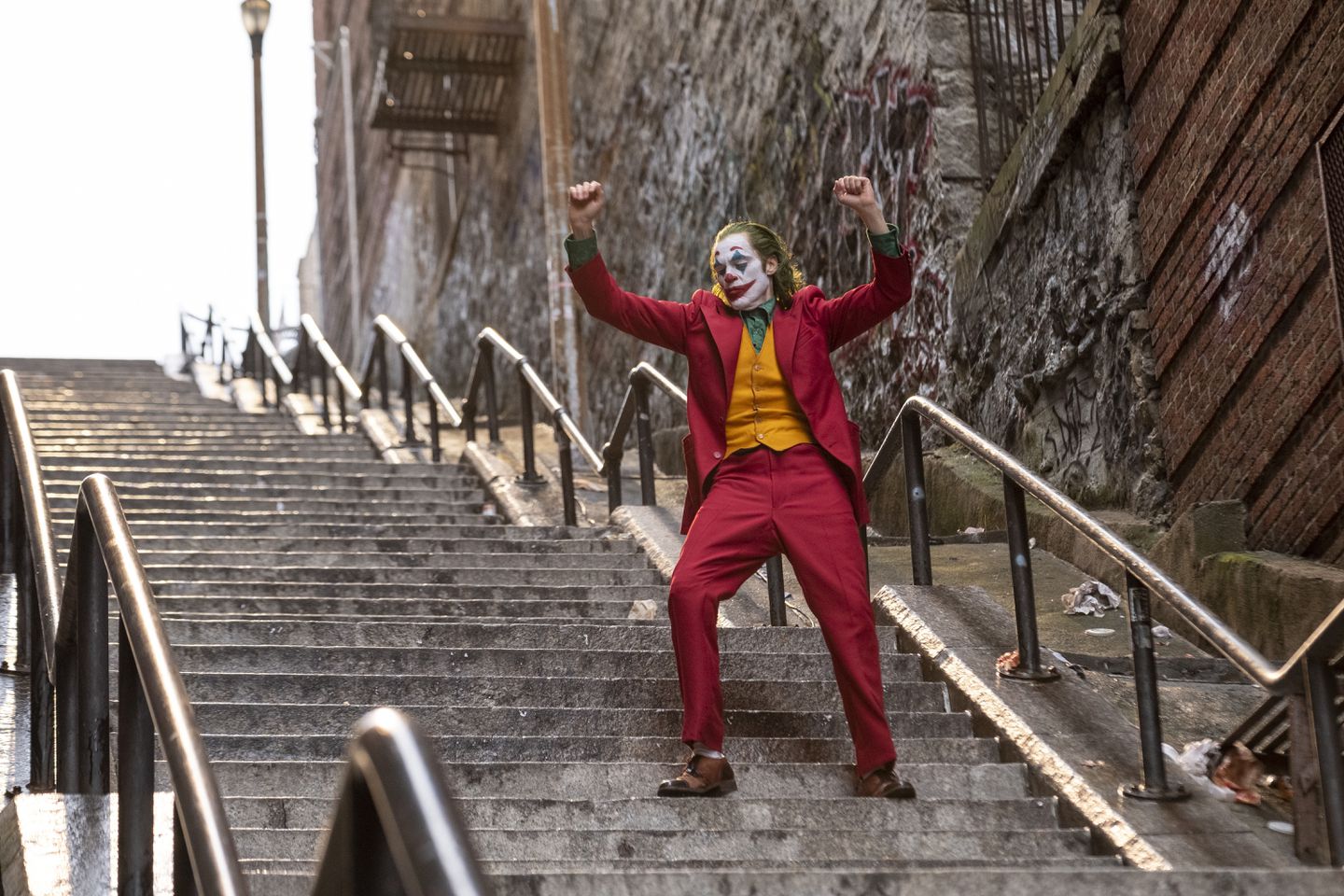
Joker (2019)


Director: Todd Phillips

Stars: Joaquin Phoenix, Robert De Niro, Frances Conroy

Short Review, no spoilers

In commandeering an origins story of the DC comics supervillain to critique both the treatment of the mentally ill and the ever-widening gap between rich and poor in western society, Joker sticks out like a defiantly awkward thumb amongst the currently over-saturated but seemingly ever popular superhero movie market. However, enjoying its own unprecedented success, Joker is a powerful, important film, controversial to some, vital to others. Joaquin Phoenix delivers a sensational performance as Arthur Fleck, a socially awkward, isolated man with a condition which causes him to erupt in to uncontrollable bouts of laughter. As dumb and crass as the Hangover movies are, director Todd Phillips utilises the somehow simultaneously slick but dirgy cinematography from the latter, and puts his ability to be knowingly provocative to better use. Robert De Niro is also excellent, playing a passive-aggressive TV anchor with too much fake tan and Botox in a casting that, while more obviously references the influences of Martin Scorsese’s Taxi Driver and King of Comedy on the film, also brings to mind De Niro’s role in Casino when the once big time Vegas man turns cheesy TV show host.

Full Review (spoilers)

Like Kick-Ass, Joker removes the superhuman qualities from superhero movies, instead approaching the genre on a very grounded, ‘this could happen’ level. The choice to focus on a supervillain rather than hero is interesting here, presenting a criminal that is societally created rather than inherently evil, a villain that is arguably more human and relatable for his flaws and more dramatically dynamic for his bad behaviour. In Tim Burton’s brilliant adaptation, the arch rivals of Batman and the Joker were in fact comparatively weird. Here Bruce Wayne is still but a boy, leaving all of the complexity to his nemesis. The titular character is a poor man (economically and in terms of mental health) in contrast to Bruce Wayne’s familial background of wealth and power, and their destined rivalry, normally attributed to revenge for the murder of Wayne’s parents, is literally incidental to the wider socio-economic issues that produce them and polarise them as individuals. As such, Joker is brilliantly prescient – despite Arthur Fleck’s declaration that he ‘doesn’t believe in anything,’ and is not political, the film rams home that the personal is political when we see that Arthur’s deterioration is inexorably linked to societal indifference and mistreatment of the mentally ill.

Joker may have proved less popular with some comic book fans and Batman purists because it is in fact an indie movie in style and a powerfully, unapologetically downbeat and raw examination of living with mental illness in contemporary society, including damning condemnation of cuts to services, and the ongoing stigmatisation and isolation experienced by mentally ill individuals. It has been divisive on this issue too, pushing the well-used panic button of apparently appearing to justify and incite violence. What is undoubtedly provocative is that Arthur is seen to become physically more graceful and self-assured following the retaliatory killing of the Wall street-type bullies on the subway, along with his increasing embrace of his condition and the role of the Joker identity. Before, his uncontrollable fits of humourless laughter are met with awkwardness and disdain, addressed by Arthur himself in one of many quotable lines: ‘The worst part about having a mental illness is people expect you to behave as if you don’t.’ The scene in which Arthur dances in slow motion to a Gary Glitter song is enjoyably subversive, alluding to the current censorship of art in which separation between art and artist is increasingly troubled territory. It is also part of a deliberate but not mindlessly risqué approach that is behind the treatment of a subject so at odds with the current model of sanitising and ‘celebritising’ mental illness. Avoiding disability stereotypes of pitiful victim or remarkable genius, and instead taking the embittered villain and inviting us to empathise with him has proved a prospect uncomfortable for some. Nevertheless, we are expected to understand that the use of the Glitter song and the portrayal of a man driven to violence does not in and of itself condone criminality. As such, the responses by some reflect the kind of moralising at the expense of missing the point that is prevalent in today’s world and precisely what the film is driving at.

There is also great poignancy. In the context of an otherwise miserable life, Arthur’s escapes in to fantasy are sad and understandable. His foray in to stand-up comedy is a perfect example of how mental illness can directly stop you from doing what you want to do most, and the fact that it is his imagined girlfriend watching and applauding that spurs him on is tragic. The link between comedy and tragedy as it pertains to mental illness is deftly explored, Arthur himself perceiving his own life switching from one of tragedy to one of comedy, something that resonates with those that understand the sometimes simultaneously devastating and ridiculous ways in which one’s mind can direct one’s actions. Even as Arthur comes across as cool and nonchalant in front of the cops that are closing in on him, he turns and walks in to a door, a moment that captures perfectly the irony of a relentlessly demeaned individual striving to obtain some scrap of dignity.

We also see Arthur as mocked reality star when his filmed stand-up routine is held up by his TV idol as Murray Franklin’s proof of yet another talentless wannabe. What was once the realm of surrealism, as seen in Requiem for a Dream when Ellen Burstyn’s lonely old lady becomes obsessed with an increasingly deluded connection with her favourite TV show, is now something that actually happens in the public humiliation of ordinary, sometimes even disabled people on social media and television. Is the sufferer crazy or society or both?

The film is also streaked with an anti-austerity critique. When asked by reporters to comment on the murders committed by Arthur, mayoral candidate and billionaire Thomas Wayne makes a misguided comment about ‘clowns’ being envious of the rich, betraying acknowledgement of a deeply divided society and the underlying anxiety of those whose interests it is in to keep it that way. Riots that follow are inspired by the statement, and Arthur unwittingly becomes a symbol of social unrest.

With all the superficial, patronising, celebrity-endorsed lip service that does more harm than good and ignores the experiences of most people with mental illness, particularly those who are poor or suffer with ‘unfashionable’ conditions, Joker is a refreshingly hard-hitting, sensitively wrought and boldly critical depiction of living with mental illness in contemporary society. During the course of the film, Arthur discovers that his mother was a patient at Arkham Asylum, and her story has the familiar ring of Frances Farmer-type incarcerations, in which the confinements of young, ‘problematic’ women in the past could have easily been politically motivated as much as for the purposes of ‘treatment’. Fast forward to the present day and, although individuals like Arthur may not be institutionalised, they are victims of the new method of ‘care in the community,’ which in fact means that they are left to slip through the cracks in to isolated and unsupported existences.

In several reviews, Arthur is described as a narcissist, regarding a complex character with the same dismissal displayed by the character’s therapist in the movie. For many, it’s easier to push such problematic individuals to one side than to tackle the potential issues they face both within and around themselves. We hear the same mindless mantra to ‘talk’ about mental illness over and over again, as if this will automatically remove the stigma and magically make us all well again. Worse still, this command to talk is delivered by members of the royal family, and is accompanied by images of highly-paid footballers, pop stars, models or whoever else is happy to jump aboard the bandwagon and raise their profile. It seems nobody really wants to hear what people like Arthur have to say, both in and outside the film. This is why I believe Joker is in fact a significant entry in to the discussion surrounding mental illness and how it relates to wider social factors.

The Irishman (2019)


Director: Martin Scorsese

Stars: Robert De Niro, Joe Pesci, Al Pacino, Stephen Graham, Harvey Keitel

Short Review, no spoilers

This is vintage Scorsese tinged with poignancy - a deeply satisfying gangster movie that deals with lifelong friendships and the pains of growing old. The prospect of the legendary director working with not only Robert De Niro, Joe Pesci and Harvey Keitel again, but also Al Pacino is as rewarding as anticipated – they’re all a little older but as compelling as ever.

Full Review (spoilers)

The film opens in classic Scorsese style: a long, unedited tracking shot moving from room to room accompanied by a 1950s pop song. Wryly referencing a device previously used to propel the viewer in to an immersive, kinetic environment, following the movements of a young and ambitious protagonist, here the camera drifts ghostlike in to an old people’s home, eventually arriving at our aged hero, stationary in his wheelchair, waiting out death. As in Goodfellas and Casino, The Irishman revolves around the life of a criminal whose reward for surviving a violent existence, even as all those surrounding him fall, is to end up alone. The difference here is that we are taken right up to the end of Frank Sheeran’s life, even witnessing him picking out a coffin for himself, and a spot for his memorial stone.

Based on true events, the film takes Sheeran’s unproven claims that he killed union president Jimmy Hoffa in 1975 as truth, building a story around it of institutionalised corruption, political intrigue, and tested loyalties. In the film as in life, both Sheeran and Hoffa are shown to be associated with mob boss Russell Bufalino (Joe Pesci) and his superior, Angelo Bruno (Harvey Keitel), ties which lead Hoffa to run in to trouble with the Kennedys, and most likely were behind his mysterious disappearance. Spanning a timeline from the 1940s to the 1990s, and cutting back and forth between various eras within this period, the film explores the development of Sheeran’s associations with both Hoffa and the mob, and the build-up to Hoffa’s assassination, as imagined by Scorsese.

A little slow to get going and with a few unnecessary sequences at the end, Scorsese’s longest film could have been shorter. Where it does pick up pace is when Pacino enters the action, the best of an excellent cast on this occasion. In comparison to the last successful teaming up of De Niro and Pacino – Michael Mann’s Heat - here, Pacino steals the show, providing a performance as entertaining if not as brash and blustering. As for De Niro, he’s understated in this film, not in the icily cool way as he was in the aforementioned, but in a somewhat more underwhelming way. Nevertheless, as in Heat, this probably works well in allowing Pacino the room to act big, De Niro perhaps knowing that a subtler performance on his part compliments their work together much better than butting heads. As a result, the friendship between Sheeran and Hoffa is believable and moving. Most enjoyable is seeing the two discuss union and mob politics in shared hotel rooms in their pyjamas; and when Hoffa has to reassure his upset friend that a ball-out in his office was not aimed at him – “I didn’t even see you there!” Most heart-breaking is De Niro’s expression when he realises his role in Hoffa’s death, and their last embrace in the back of a car on the way to Hoffa’s demise.

Pacino is also at times very funny, contributing most to the humour that is not unusual amongst all the machismo and violence in a Scorsese movie. Following the unhesitating and emphatic beating of a would-be assassin by Hoffa’s son Chuck, Hoffa immediately launches in to enthusiastic praise for Chuck’s actions, and goes on to tutor the assembled journos on the best way to deal with an assailant depending on what weapon they have: “You always charge a guy with a gun! With a knife you run away.” Later, in a brief moment of what is surely unscripted, uncorrected improv, Pacino abruptly backs in to the unprepared actors behind him, showing Hoffa’s eagerness to demonstrate spirited bullishness to more photo-snapping journos. And in characteristic Scorsese fashion, whereby we bear witness to the potentially fatal danger in causing offence when involved in mob fraternities, there is a degree of comedy in Hoffa’s heated bouts with fellow union leader Tony ‘Pro’ Provenzano. During these tense exchanges the increasingly known threat to Hoffa’s life is a dark undercurrent to two men struggling to repress a trading of personal insults. Stephen Graham, as said thorn in Hoffa’s side, is brilliant as always, holding his own amongst the heavy-hitters and again demonstrating why he’s up there with them – an assured, fluid performance.

Joe Pesci is also excellent as Russell Bufalino, out of retirement and reunited again with Scorsese and De Niro, who broke him as a star way back in 1980 with Raging Bull. As with Hoffa and in real life, Sheeran/De Niro shares a friendship spanning several decades with Bufalino/Pesci, one which in the film forces him to choose between the two of them. Sheeran and Bufalino also share poignant moments, such as a flashback to their first meeting, and the sharing of bread as they grow old in prison together. Sadly, another moment is tinged with cynicism, when Bufalino gives Sheeran a ring to symbolise his acceptance as a ‘made’ man in the mob. Not coincidentally, the gesture immediately follows Sheeran’s heartfelt request that Hoffa speak at a testimonial dinner in his honour, and is in fact ushered in to complicate Sheeran’s loyalty, as the mob close in on the assassination of an increasingly mouthy and out-of-control Hoffa.

Anna Paquin as the adult Peggy, one of Sheeran’s daughters, doesn’t have much to do, but rather her character serves as a moral gauge. In quietly observing more than her father would like, she demonstrates an instinctive dislike of Russell while at the same time forming a warm, close bond with Jimmy, despite both lavishing her with attention and gifts. Her reaction foreshadows what the film suggests was the wrong way for Sheeran – with Russell and against Jimmy. Another very good performance, surprisingly, is Ray Romano (of US sitcom Everybody Loves Raymond) as Bill Bufalino, Russell’s cousin and lawyer to all involved. And Harvey Keitel regains dignity after the car insurance adverts, hence it would have been nice to see more of him in this film.

The use of technology to ‘de age’ the actors has had mixed responses; in the opinion of this reviewer, it was more successful than expected and, although imperfect, did not distract from the telling of the tale as a whole. What it did prove is that is less easy to restore the physical agility of youth, De Niro in particular moving with the stiff grace of an older man most apparent when stomping on the hand of a shopkeeper that had made the mistake of physically disciplining a young Peggy. However, discussions on how to manage the physical side of aging actors are less interesting than the manner in which the film engages with matters of the soul when growing old, particularly when reflecting on a life which, whether or not actual regret is there, there is much to repent for. Even at the end of his days, Frank tells a priest that he doesn’t regret the suffering he caused others in a life littered with violent deeds. What is alluded to however, is the pain of an unforgiving daughter, seen curtly closing her counter as a hobbling Frank attempts to approach Peggy at her job in a bank. This brief scene is another that is beautifully played out, and one sequence in the final segment of the film which is worthy of inclusion. The build up is slow and the significance unclear, as Frank queues for a lengthy period before ushering a fellow customer ahead of him. Then the camera spins right to show Peggy abruptly leaving her position before Frank can speak to her, literally closing the door on any final reconciliation.

In another darkly humorous aside, captions appear throughout the film which inform us of the violent deaths of various characters. Near the end, Sheeran is questioned by FBI men in a last-ditch attempt to get him to confess to which Sheeran demands to see his lawyer. The FBI inform him that Bill Bufalino is dead – they’re all dead. Sheeran’s immediate response is: “Who did it?” The punchline is that he actually died of natural causes - cancer. Like Bill, Frank and Russell are two of the few that avoid death by murder. The film appears like a swansong, about knowing when one’s time is up, something that, unlike most others, Russell and Frank are afforded. Russell dies in prison, seen wheeled in to church to finally confess when he realises his own end is nigh. Frank lives long enough to finish his time in ‘school,’ but subsequently goes through the process of addressing his own death in unavoidable detail, alone and with the pain of unforgiven sins.

If The Irishman is Scorsese’s own swansong on the other hand, it would be a regrettable loss to the film world, but also undoubtedly one composed gracefully and stamped indelibly with his unique style.

The Exorcist (1973)


Director: William Friedkin

Stars: Ellen Burstyn, Max von Sydow, Linda Blair, Jason Miller

Short Review, no spoilers

Shocking horror classic - banned on video in the UK from 1984 until 1998 - in which a young girl in modern day Washington becomes the victim of demonic possession and must undergo an exorcism.

Full Review (spoilers)

Over the decades, The Exorcist has been variously met with shock, disgust, applause, dismissal, and adoration, with its banning from video release by the BBFC in 1984 only adding to its notoriety. Perhaps one of the most fascinating things about the film is that it has been different things to different people at different times, shifting mercurially in people’s perceptions much like the demon at the centre of the story. In the wake of the original release of the film, the church condemned it, audience members fainted, and others ran out in terror. Following the lifting of the video ban in 1998 and subsequent re-release, there was much hype, including a celebration by Mark Kermode, who has always lauded it as his favourite film of all time. In fact, the hype probably inadvertently contributed to many of the reactions which were much less reverent, greeted as the film was by ‘how many killings’ types who were unimpressed by what was seen as dated special effects, and a film that works as hard on atmosphere and a sense of dread as the icky, pukey, head-twisting bits. Neither reactions do justice to what is in fact a complex and beautifully filmed work of art, which evolves every time you see it, and lends itself to multiple interpretations.

The Exorcist is a genuinely frightening film for less headline-grabbing reasons as well as for the overtly graphic horror that caused all the initial kerfuffle. The tension builds gradually and innocuously, complemented by the naturalistic acting and the scene-setting of a very grounded presentation of reality; although Regan’s mother is a Hollywood actress filming her latest in Washington, there is a high degree of authenticity which holds in perspective the more commonly advertised glamour of movie stars. It also serves to render the supernatural elements of the drama and Regan’s extreme behaviour that much more powerful, upsetting so drastically as it does an otherwise relatively serene and quite ordinary equilibrium. The film is balanced by creepy, unnerving sequences as well as the alarming scenes of Regan’s horrifying behaviour: an unsettling, abstract fear is built in the opening scenes, as Father Merrin unearths archaic deities in Morocco; the introduction of ‘Captain Howdy’ in Regan’s casual use of the Ouiija board; her mother Chris’ investigation of weird noises in the attic; Regan’s deadpan threat and urination in front of her mother’s party guests; her various ominous utterings and the revelation that she is speaking backwards; the almost subliminal flash of a demonic face in Father Karras’ nightmare; the description of Burke Jennings’ unseen violent death as described by Detective Kinderman; and the clouds of breath in Regan’s deathly cold bedroom when she has succumbed to the demon and awaits exorcism.

As for the more overt horror imagery, Regan’s transformation from sweet, cute young girl in to a grotesquely deformed, rasping monster remains as horrifying and perversely fun to watch as ever. There is undeniable feminist joy in witnessing a once good girl approaching a not insignificantly pubescent age in the messiest, angriest way ever, reacting to the pokes and prods of various male authority figures by grabbing their balls, puking in their faces and tossing out verbal obscenities with the purest, most unfettered rage and velocity. In 1993, Barbara Creed wrote excellently on this subject (amongst others concerning horror and ‘the monstrous-feminine’), identifying Regan’s physical and behavioural abjection as a spectacular resistance to female propriety and, at a deeper psychic level, the patriarchal order itself. She also points out that although a kind of equilibrium is restored at the end, the two male priests have died in the process, and mother and daughter are reunited in what is actually something of a symbolically incestuous relationship.

In a completely different reading, albeit one much less juicily Freudian, it struck me recently as also rather tragic. Seeing Chris’ face, fraught with worry and helplessness at her daughter’s increasingly out-of-character behaviour, and Regan’s visible pain, fear and discomfort at the hands of clueless doctors resonates with the dreadful reality many endure in the course of being diagnosed and treated for mental illness, including children and their parents. It also calls to mind the medieval quackery involved as, throughout history, various types of ‘physician’ have floundered around the human body, trying to find answers to its physical and psychological mysteries. The clash of the ancient and the modern in The Exorcist exploits the tension between the imaginings of contemporary society as civilised, scientific and certain, and those of the past that are mired in barbarism, spirituality and the ignorant meddlings of experimentalists, leading to the awkward question of how much further along we really are.

Whatever it does for you, The Exorcist is undoubtedly an unforgettable film that’s different every time you return to it, and deservedly an iconic classic of the horror genre.

The Blood on Satan’s Claw (1971)


Director: Piers Haggard

Stars: Patrick Wymark, Linda Hayden, Barry Andrews

Short Review, no spoilers

Cult British witchcraft horror produced three years after Witchfinder General and with an eye on the success of the latter; notable for its subsequent appreciation as an example of folk horror, its atmospheric location shooting, and effective soundtrack.

Full Review (spoilers)

The Blood on Satan’s Claw emerged in the wake of Witchfinder General (1968), exploring similar subject matter without receiving as much initial acclaim as its predecessor. However, it has gained cult status over the years, as recently acknowledged by Mark Gatiss in his tribute to its influence on the brilliantly disturbing The League of Gentlemen TV series. It’s also interesting for its differing position on witch-hunting to the Vincent Price-starring classic - here the witches are real, and the witchfinder is not as straightforwardly dastardly, ultimately saving the day as he does in a village riddled with young ‘uns corrupted by devil-worshipping witchery. This is perhaps due to the context of the Manson murders and trial (1969), reflecting as it seems the ‘free love’ hippy dream turned sour, and subsequent terror of radical, hopped-up, out-of-control kids easily influenced and corrupted by evil.

The film was shot entirely on location, predominantly in Oxfordshire, and captures the English rural landscape very well. Essential to the effectiveness of the film, it brings atmosphere and authenticity. The excellent soundtrack is also beautiful to listen to, and an example of film music that can be enjoyed in its own right. It is also interesting to note that composer Marc Wilkinson is said to have advised Paul Giovanni, who sound-tracked the more famous bedfellow of the so-called folk horror sub-genre, The Wicker Man.

The film itself is a very entertaining horror of its kind, although we do have the tired cliché of witch movies whereby a manipulative saucepot cries rape unjustly - against an honest schoolteacher priest no less! Also, typically of exploitation film there is an unnecessary big-titted temptress at the end, wobbling around daftly as a hypnotised youth wields a knife. Nevertheless, Linda Hayden as said saucepot is very good, suitably troubling and demonic.

It’s engaging throughout, making it a shame that the final confrontation is disappointing - the demon is revealed more thoroughly and subsequently looks ridiculous. The monster around which these disturbing events revolves is far scarier before with the less-is-more approach.

Savage House (2026)

Disappointing mash-up of A Rake’s Progress and Dinner at Eight that misfires the period rudeness of The Favourite to achieve something more ...