Friday, March 29, 2024

M3ghan (2022)


M3ghan (2022)

Director: Gerard Johnstone

Stars: Allison Williams, Violet McGraw, Amie Donald, Jenna Davis (voice)

Short Review, no spoilers

When M3ghan first came out at cinemas, it seemed to be sold as a straight-up horror movie in the sense of both another entry in the creepy doll genre and also the latest model from production company Blumhouse. However, it is actually a refreshingly dark and clever satire made with the kind of smart restraint that will frustrate anyone demanding only ‘how many killins’ and ’ooh how it made me jump’ thrills when the real chill factor is how insidiously and seductively the promotion of technology seems to promise the solution to all of our age-old human life problems.

Full Review (spoilers)

The opening scene of M3gan was perhaps the most horrifying for me when I first saw it at my local movie house. Thinking it was yet another bloody tacky advert after the millions I’d already watched, I was soothed and amused when I realised it was a satirical start to what is a very clever and critical film. Beginning with a cheesy and hilarious commercial much like Westworld - another robot-gone-wrong movie – here we are introduced to the competitive arena of toy-dom. There on in the threat of AI and its hurried, irresponsible use to make profit is again explored but here with the added complexities of modern era child-raising.

Thus, from the beginning, we are met with bolt after bolt of sometimes very darkly funny stabs at our increasing dependence on technology and how it seems to have overridden common sense in various scenarios. Even the tragic car accident that kills eight-year-old Cady’s parents at the beginning culminates after a conversation that reveals them to be typically modern, middle class and non-real world existing parents, believing that absence of an electronic device will cause their child to go postal, and reliance on a car that looks like a four-wheel drive will be enough to get them through a dangerous mountain drive through a blizzard.

Even more clueless is Cady’s aunt Gemma, who inherits her niece after the deaths of Cady’s parents. The film frankly depicts Gemma’s ineptitude as a guardian - despite being a toy designer, she barely knows how to communicate with a little girl, even her own niece. In another swipe at the inadequacy of technology as replacement for everything, Gemma has to wait for a bedtime story to download on her smartphone because she doesn’t have any books, but the film also refreshingly brings us an authentic depiction of a woman who is not at all maternal (yes, they do exist). What Gemma and Cady do end up bonding over is Cady’s own drawing efforts and interest in Gemma’s old college project, a robot called Bruce. This in turn inspires Gemma to abandon a less interesting deadline and nail down a prototype she is more passionate about. She works solidly on the life-size doll-robot to produce M3gan, in what she hopes to be a kill-two-birds-with-one-stone effort at driving through an ambitious project at work and also appease her bereaved niece.

M3gan is an instant hit, both with Cady and with Gemma’s boss. Even a sticky moment when Cady breaks down in tears during a display for the board is overcome in style. M3gan turns it around when she successfully consoles Cady and rescues the presentation, proving her/it-self to be even more valuable than anyone expected and sealing the bond even more with Cady.

If a toy being used as replacement for parenting was dubious enough, M3gan goes above and beyond, showing that she is able to do more than any parent. Herein lies a pertinent quandary facing all those responsible for children right now, as the temptation to allow them to learn everything they need to know via the internet can be all too easily given in to. M3gan is inextricably linked to the seductive but impersonal possibilities of the internet – she needs to know everything, always be one step ahead, and, like an algorithm, be constantly adapting to changing human interests. She proves to be hard to keep up with, performing one function one moment before switching to an entirely different one the next in a way that would be deemed psychopathic in a human.

But so goes what would seem to be a perfect arrangement, with Gemma unburdened of caring for her ward, and Cady seemingly flourishing with a new best friend. Linda Hamilton’s observations on Arnold Schwarzenegger’s android in Terminator 2 are called to mind, when she sees her son fall in love with the most reliable father figure a child could have. M3gan takes this role about 50 times further, providing Cady with a companion and tutor as well as a protector. The latter is where things get dangerous, as any harm visited upon Cady creates a major grudge in her new pal’s hard drive. The neighbour’s dog bites Cady so that’s the end of him. But when a hate-filled bully boy gets heavy with Cady at some dastardly open day for an alternative school, things get human-murderous.

Like all of the characters in the film, the over-indulged, violent misogynist in the making that is the bully boy is very well written. If you have been unfortunate enough to have encountered such a type, it will ring some very resonant bells. Left partnered and alone with the boy in the woods, Cady is soon exposed to his rough treatment until M3gan shows up and his attention is diverted. Turning his less than delicate touch on to the doll and lifting up her skirts, naturally he gets way more than he bargained for. The filmmakers don’t mind indulging us in some neatly dark retaliation, as M3gan displays some of her most deliciously deranged moves. From ominous stillness in the cold, misty light of the forest, she takes to all fours and gallops like a rabid animal, a similarly grotesque distortion of a sweet little girl in shades of Regan in The Exorcist.

As with Yul Brynner’s monstrous robot in Westworld, the film creators of M3gan understand the disturbing physicality of a fantasy object made odd by sophisticated physicality that is still visibly unnatural. M3gan is cute in theory but, as with the robots in Westworld, it’s the eyes that first give it away. As expertly as she has been designed, the creators still haven’t got past the dead glass eyes that even the most beloved dolls always have. In true uncanny fashion, M3gan is repeatedly viewed as acceptable and harmless from a distance but unnerving close up. And even when M3gan isn’t behaving badly but doing what she’s supposed to, she can be hilariously weird in a way that only children and fans of modern music will accept, as demonstrated when she comforts Cady with her saccharine rendition of popular song ‘Titanium’. Her perversity is explored to its fullest though when she dances provocatively like a child beauty pageant contestant in front of Gemma’s boss, before slaughtering him mercilessly with a paper cutter (this as well as M3gan’s physicality throughout the film are owed entirely to the exquisite choreography and smart dexterity of Amie Donald, cast to enact the body of M3gan).

Aside from all the fun though, M3gan has significant things to say about the dehumanising aspects of over reliance on technology. Even before she realises how dangerous M3gan is, Gemma recognises that the doll is not helping Cady deal with grief as she had hoped it would. Feeling better is important, but what M3gan and other forms of reality escaping would seem to advocate is an intolerance of suffering at all. In not dealing with the unfortunate essentialism of suffering, Cady finds herself struggling to relate to other human beings. It is also Cady’s prevention from confronting grief that feeds M3gan’s unwieldy impulses, as after all, M3gan is a reactive product that is fuelled by technologically bonding with a child, and said child hasn’t had the chance to develop a mature conception of psychological pain. So it goes, neither does M3gan …

Ultimately and even after the happy ending when all has been taken care of, the film ends with a pointed shot of Gemma’s virtual assistant voice service (something that a lot of people already use in the real world that begins with ‘A’ to give you a clue) as if to warn that we are already on the journey to such disastrous events if we’re not careful …

Wednesday, March 27, 2024

Westworld (1973)


Westworld (1973)

Director: Michael Crichton

Stars: Yul Brynner, Richard Benjamin, James Brolin

Short Review, no spoilers

A seminal science fiction film, Westworld came about during a nihilistic time for the genre before a more optimistic generation came crashing in with A New Hope. A stripped-down masterpiece with a hauntingly avant-garde portrayal of a robot from Yul Brynner, the film features groundbreaking effects and paved the way for a variety of influences in the future.

Full Review (spoilers)

Peter Martin : You talk too much.

Robot Gunslinger : You say something, boy?

Peter Martin : I said you talk too much.

Robot Gunslinger : Why don't you make me shut up?

There’s a pleasing irony in this rare piece of speech from Yul Brynner as the Gunslinger in Westworld pertaining to some acting advice Brynner shared with co-star Richard Benjamin. Brynner believed that the less said the better, giving what little is said more impact. This ethos could apply to the style of the film as a whole, which gives us no character detail and not much build up to the action, instead briskly running the viewer through a nightmare that begins satirically and ends violently. As stark and spare as this vision is however, it gave birth to several ideas that were developed in later films, three of which starred Arnold Schwarzenegger. Machines turning on humans in The Terminator is the most obvious, but the cheesy commercials for futuristic holiday thrills which involve customers taking on different personas is also very Total Recall. Then there is the visualisation of seeing through the digital eyes of a computer-assisted monster in both Predator and The Terminator. Also in Predator is the use of coloured heat detection to hunt down human prey, and, even in a quite different genre, orchestrated characters who wait frozen until scheduled to act out their false environment is seen very familiarly in The Truman Show.

For sheer ruthlessness in an android, see Brynner’s influence on Terminator 2 and T1000’s terrifyingly frozen expression and efficient body movements. In Westworld, the Gunslinger turns from obedient plaything to menacing assassin, the cowboy swagger with thumbs hitched to gun holster perversely maintained even as he transforms from laconic tough guy to demented hunter, stalking unstoppably after his prey.

If Brynner’s robot performance is successful however, it is also conversely because there are traces of something more than a machine or monster. The Gunslinger is at times somehow melancholic and pitiable - a picture of faded elegance, he’s shot down repeatedly by dumb tourists who ape the epic fantasy that was the Wild West. Brynner’s outfit is exactly the same as the one he wore in his iconic performance from the classic western The Magnificent Seven, a ghostly reminder of past glories. The star persona of Brynner and the robot co-mingle, with the Gunslinger’s wavering, not-quite-human manner of behaviour interacting intriguingly with the enigmatic persona of Brynner himself. All supports the postmodern acknowledgement of fantasy – and particularly, fantastic masculinity - as construct, but there is a sense of tragedy in this. Brynner is visibly older but still compelling, a strong physical presence, but one that is faded and dusty and part of a fake set that is trampled through by credit-card-in-the-air yuppies. It’s like romance dying, replayed over and over each time the Gunslinger is shot dead, something that seems to be confirmed by the director’s decision to film his deaths in slow motion. In giving these moments gravitas, they contrast distinctly with the delighted guffaws of the tourists as they enact the killings. The robots are exploited like slaves, as in Bladerunner. Indeed, there seems to be some reference to this in the name of the holiday park as Delos, the same as an island that in ancient times was the site of the largest slave market in the world.

With old-fashioned reverence for classic movie stars seemingly in the dust, things take a swift turn when the mechanics of the robots begin to malfunction. Refusing to be played back over and over again, the robots break out of the fantasy and destroy the consumers. Like all great sci-fi, it begs questions about humanity, morality, society and culture, and delivers warnings about developing technology too quickly, greedily and irresponsibly … So before AI enthusiasts get excited about sympathy for the robot-devil, see the following:  https://filmstories.co.uk/features/westworld-the-race-to-make-one-of-the-most-important-films-of-the-early-1970s/ - a succinct and fascinating summing up of the making of the film and Crichton’s real intention, which was not anti-technology as such, but anti-corporate greed and its abuses of technology for profit.


A Night to Remember (1958)


A Night to Remember (1958)

Director: Roy Baker

Stars: Kenneth More, Michael Goodliffe, Laurence Naismith

Short Review, no spoilers

Sometimes the very facts of an incident are tragic enough, requiring no sentimental embellishment or special effects bedazzlement. This is how we find A Night to Remember, a film that documents the notorious sinking of the Titanic in 1912 in detailed and humanistic fashion. We see what happened to the many not the few, with the curious divisions between rich and poor, and women and men, in a manner that draws upon our natural sympathies rather than those manipulated by narrative devices. As briskly edited and broadly attentive to a vast ensemble of characters as the film is, it is far more powerful as a result, and a stand-out of the disaster movie genre.

Full Review (spoilers)

In an early scene of A Night to Remember, the second captain jokes with his wife over a soap advert that is promoted via a link to the Titanic’s voyage to America. A pompous couple sharing the train carriage chastise him for his flippancy, asking if he is either a foreigner or a ‘radical’. This shows the extent of the Titanic as a symbol of national pride and mechanical progress, and is an early hint at what subtly pervades the whole film in terms of social criticism. It is to say that, of the numerous mistakes made, the sociological is a vital point - the promotion of pride, wealth, status and progress embodied in the ship overshadowed the practical and safe planning of a vast ocean voyage transporting two thousand people with ultimately devastating consequences.

From then on, the film flits from scenario to scenario, addressing the all kinds of folk that made up the passengers of the famously ‘unsinkable’ Titanic, from the run-up to boarding before a devastating real time account of the ship’s final hours. We see the coach drawn elite who are bid adieu by common school girls, who are themselves dismissed as merely ensuring their annual Christmas turkey; the homely goodbye between the second captain and his wife; and the farewell party of well-wishers from an Irish village as migrants embark upon a new life in America.

On board, we see the various facets of society as they are placed on the ship – the wealthiest passengers in first and second class, the coal shovellers and poor folk down below, and the rest of the crew including wireless operators and of course the captain, as well as the builder of the ship who still scans construction plans for flaws. The irony of this latter action as well as others is exploited throughout to elicit winces of recognition however, knowing the outcome makes the unfolding of events no less tense or tragic, and perhaps even amplifies our emotional investment.

Perhaps some of the most painful facts pertain to the contrast between the actions of the crew of the Carpathia, a ship with no chance of reaching the Titanic before it would sink but with a captain doing everything possible to assist without hesitation, and those of the Californian, who were far closer by all accounts but who, for whatever reason/s, failed to assist until it was long too late. It is crushing to witness, but the film plays out the tragedy as even-handedly as drama can allow, acknowledging human folly and the horror of a catastrophe made up of a myriad of accidents and errors.

An excellent job is done in terms of effects (filming in black and white likely helped) - artificiality is disguised well and in fact blends impressively with the mostly human-based action that the film revolves around. Translating well the thorough research of the book it is based on, the film uses technical detail as convincing background to the foregrounded play of human nature, keeping the film convincingly authentic without sacrificing compelling drama.

Kenneth More as the second captain is top billing and the closest to a lead hero but ultimately it is very much an ensemble piece. Dignity and level-headedness in dealing with the unfolding crisis also come across inspiringly in the performances of Laurence Naismith as the captain and Michael Goodliffe as the ship builder along with however, a haunted look of responsibility visible in both men. A chef who takes to drink is the closest thing to comedy, although inevitably this comes with an edge of melancholy. Couples and families deal with what is likely to be everlasting separation, while the poor fight to be afforded the chance for survival as the rich bitch peevishly and outrageously until the end, even as the ship goes down in screams. The crew are shown as professionally brave and there is something authentically reassuring in their stoicism, more than in the fantasy swaggering heroism of typical movie life savers. Of course, as a balanced observation of human nature there is also cowardice, but we see it with sadness rather than judgement. The desperation spills over as the ship gives her last gasps, and we witness the lunacy of a fight for survival. There are opposite examples again though - just as one is following the ‘every man for himself’ ethos, he eventually hesitates to help a woman in plight; an elderly man takes a lost child in his arms and holds him until the end; and a violinist in the loneliest of images is rejoined by his fellow musicians to play with him as the ship goes down.

A gripping masterclass in editing and tension building, while keeping a firm grip on the human side of this tragic disaster - don’t bother with that fluffy James Cameron movie, this is far classier stuff.

Saturday, March 9, 2024

The Zone of Interest (2023)


The Zone of Interest (2023)

Director: Jonathan Glazer

Stars: Christian Friedel, Sandra Huller

Short Review, no spoilers

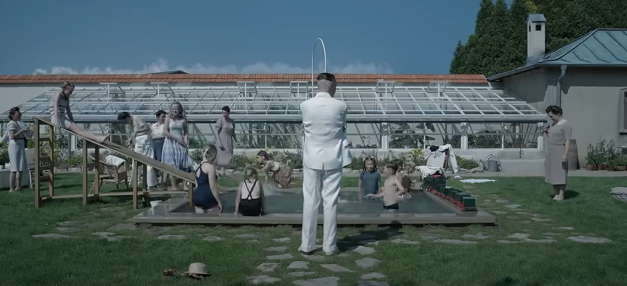
A quietly devastating, intelligently made window in to the world that was the household of Rudolf Hoss when he and his family lived in immediate proximity to Auschwitz while the commandant was stationed there. The excellent Jonathan Glazer’s aesthetics of distanciation channel Hannah Arendt’s observations on the banality of evil, as we witness the bizarrely ordinary life of a direct participant in some of the worst atrocities ever to be committed by one set of humans on another.

Full Review (spoilers)

The wait for the next Jonathan Glazer film always feels too long but The Zone of Interest marks an exceptional return to cinema screens for the filmmaker. A vital and valuable addition to works of art that take on the horror of the Holocaust, the film zeroes in on the household of Rudolf Hoss as one small aspect of a time and place in history that was utterly shameful in its acceptance of brutality on an unprecedented scale.

There are many ways to take down monsters – they can be defeated as objects of horror and fantasy, ridiculed as objects of comedy, but perhaps the most uncomfortable is to see them as versions of ‘us’. The Zone of Interest doesn’t tell us what we already (should) know, but instead presents us with the disquieting images of a seemingly ordinary family who live as if blissfully unaware of the war crimes occurring over the garden wall of their house. The opening scene is of a family picnic by the river, where at one point, men and women separate. In one of many pointed ironies, we think of the segregation of men and women as they are divided in to groups of those to be killed and those put to work in the most opposite of circumstances. Next, we see Rudolf’s birthday, but the familiarity with SS uniform entwined with cosy family scenes and colleague deference is disorientating, not through farce but through a disturbing realism that depicts a participant in hellish deeds as the upstanding leader and family man he and those surrounding him understood him to be.

In typical style, Glazer delivers powerfully and purely through the aesthetics of film, refreshingly so in a world that increasingly embraces either the dumbed down literal or hollow fantasy. As such, those that understand aren’t patronised and those that don’t are compelled to look deeper. When Rudolf’s wife Hedwig and her female servants and companions receive a sack of dresses and Hedwig tries on a fur coat and lipstick in the privacy of her bedroom, it is presented as just another regular event in the housewife’s life. However, the understanding behind it is enraging in that we know these are belongings pilfered from murdered prisoners. Even worse is a meeting between Rudolf and engineers discussing the construction of a multi-functioning slaughterhouse/incinerator which will eradicate and dispose of beings with the utmost efficiency, conducted as if it were just the latest in factory mass production.

The arrival of Hedwig’s mother presents an interesting perspective of someone biased by her relationship with the Hoss family and compliance with Nazi ideology however, until now, also never in a situation to see its results at such close quarters. It is a standard motherly visit at first, as Hedwig proudly gives a tour of the home and tells her how they’ve decorated it, before walking mother through her treasured garden with all of its colourful fauna and pleasant gazebo to sit in at the end of it. At one point, Hedwig’s mother wonders if the Jewish woman she used to clean for might be over the wall, an observation that is unsettling in its nonchalance but also illuminating in its acknowledgement of a reversal of fortunes that is as wildly oppositional as it is arbitrary. As benignly as mother’s visit begins however, she is seen to be perturbed when she coughs uncomfortably during an evening recline in the garden, and peers worriedly at the flames billowing from the camp from her bedroom window at night. She leaves abruptly in the night with a note for Hedwig, whose resulting humiliation instigates a calmly delivered threat to the Jewish girl servant who unknowingly prepared breakfast for the recently departed house guest.

The most significant disruption for the Hoss’ however, is the order for Rudolf to be transferred, and Hedwig first reveals her brutality when she erupts at a servant at the prospect of having to leave a home and lifestyle that means so much to her. It is moments like this as well as the general sensory experience of watching the film that cleverly and disturbingly threaten to lull the viewer in to tolerating the Hoss family situation, in a manner that uncomfortably acknowledges human vulnerabilities to acceptance of atrocity, a warning that must never stop being repeated. It takes active participation to snap out of it, to remember that this is not right, to recognise the sounds and sights of human suffering even if they are in the background, and to recognise that a mother’s genuine fight for her family’s future is one built on that suffering – her ideal family home next door to a death camp.

Another dark irony is the notion of sacrifice, as in a husband separated from his family and a scene where Rudolf bids an emotional farewell to his beloved horse. As passionately as Hedwig pleads to be allowed to bring her family up where she believes is best, the reality is shown when we see her endlessly crying baby neglected by both mother and nanny, the latter of whom unhappily endures it by swigging from a bottle. It is as if the Hoss baby’s cries have merely melted in to the sounds of anguish that are a constant in this perverse homestead, as well as the lines of ash clouds that linger permanently on the horizon.

Predominantly, we see the Hoss family from a Kubrickian distance, in this case seeing clearly with our eyes but in ways that do not encourage us to empathise emotionally. We see them acting as ordinary people to thwart any hopes that the Hoss’ were uniquely sub-human, fantastical monsters, but at the same time with a distinct effort to withhold sympathetic identification with them. It allows us to look and study and feel without the guilt of complicity, while also enforcing Glazer’s efforts to depict Auschwitz and the house powerfully but not fetishistically. There are also moments in the film that abruptly break with the objective, Big Brother style surveillance of the house when we see scenes of a little girl hiding fruit in the camp at night filmed with a thermal imaging camera. She is a local girl and member of the Polish resistance, her risky efforts seen stylised in black and white in direct contrast to the Hoss house scenes, which were shot in as natural and unembellished a way as possible. This also expresses Glazer’s given intention to film the resistance girl’s scenes as ones of activated efforts, as ones of hope, in direct opposition to the naturally unfettered ‘bleak’ images of colour employed for the daily life of Hoss’ family in Auschwitz.

Added to the overall impressiveness of the film itself is the dedicated research that went in to making it. Glazer is reported to have spent extensive time researching the project, likewise sound designer Johnnie Burn, who embroiled himself in hours spent and hundreds of pages written on how it likely sounded to live in such close vicinity to a notorious death camp. Admirable work indeed and extremely effective as a subtle aural depiction of hell on earth, quiet but unmistakeable and disturbingly constant. In fact, I’ve never been more convinced of a worthy sound award winner before so here’s hoping he can add an Oscar to his recently received Bafta.

Although clearly a brilliantly constructed film, the film is also indelibly touched by reality. Most movingly is the true story behind the Polish resistance girl, which is well worth looking in to. The final scenes seem to touch on the relationship between present and past, and between fiction and documentary, when Rudolf descends a staircase pausing between abrupt bouts of vomiting, and then stares down a dark corridor. His gaze is directed at the camera, the viewer, and then the film cuts disorientatingly to present day scenes of cleaners in what is now the Auschwitz museum. It is a disarming and open-ended conclusion but notably even more banal than the Hoss house scenes. A warning perhaps? Beware the banality of evil, the evidence of suffering on a disastrous scale becoming everyday objects. Or perhaps remembering that what were once everyday objects to the poor victims have been preserved in the museum to remember how horrifically their meaning was transformed by genocide. Either way, Jonathan Glazer’s immense effort at capturing just a piece of what is an overwhelmingly tragic piece of human history is welcome, important and exceptionally well made.


Friday, March 1, 2024

Silver Linings Playbook (2012)


Silver Linings Playbook (2012)

Director: David O. Russell

Stars: Bradley Cooper, Jennifer Lawrence, Robert De Niro, Jacki Weaver, Chris Tucker

Short Review, no spoilers

If you - as I was when I finally forced myself to watch this film – are cynical about how well Hollywood treats the subject of mental illness, as well as the talent and likeability of Bradley Cooper and/or Jennifer Lawrence, I implore you to watch this film. Thankfully and for once, there is humour that isn’t mocking, frankness without tragedy, and a lack of oversimplification or cliché. And the chemistry between the two leads is a delight.

Full Review (spoilers)

Finally, a movie that is sympathetic to the experience of mental illness, and a mainstream Hollywood one at that. Also, one that celebrates the ordinary rather than the freakish, and one where the comic and the tragic is balanced well. There is poignancy in the strained but loving relations between norms and sufferers, as well as acknowledgement of the humorous irony of the banal and absurd often brought together in experiences of mental illness. Like Pat’s parents’ puzzlement at his wearing of a garbage bag, and the friend from the psychiatric unit who obsesses about his hairline, all is addressed the same and sometimes it’s funny but not cruelly or patronisingly, only merely part of the busy mosaic that is a sufferer’s ‘normal.’

Bradley Cooper’s believable and charming performance as Pat provides a welcome portrayal of a young man with mental illness that isn’t a stereotype but a regular guy who loves football and Metallica. When Pat meets Tiffany, (Jennifer Lawrence) a young woman struggling with the death of her husband, they bond over medications and a shared experience of not fitting in. Although perhaps unrealistic at times – it seems wholly ill-advised to play along with one of a sufferer’s chief concerns in the way that Pat is encouraged to – it’s movie-forgivable in the context of the building romance between Pat and Tiffany.

The humour and life lessons are not for the sufferers only and there is great satisfaction in Pat’s recognition of the comparative troubles of his relatives and friends. Pat advises his friend to get help for himself when he confides marital problems to him, and calls out his father’s own compulsions over remote controls – “That’s OCD, that’s crazy.” Showing that angst and weird behaviour is all part of a spectrum, the film also highlights how the diagnosed are forced to accept these issues in themselves while apparent norms think they’re above such quandaries or try to bury them.

A great deal of the success of Silver Linings Playbook is owed to a complimentary collection of sensitively delivered performances that also have enough bite to prevent over-sentimentality. Robert De Niro as Pat’s dad is particularly worthy of mention, displaying in one particular scene a disarming and heartbreaking vulnerability rarely seen in the legendary tough guy. I would go as far as to say it is one of his best and deserved an Oscar.

In keeping things matter-of-fact and not melodramatic or cartoonish, the build-up and finale of a dance contest provides the happy ending that pleasingly celebrates being average – literally. Tiffany is a good but amateur dancer who teaches beginner Pat to partner her in a contest, something she never got to do with her husband, and with the promise of delivering a letter to Pat’s estranged wife in exchange. Avoiding a spectacular zero to hero denouement, we are merely presented with creativity over professionalism, as the couple perform an exhilarating and eclectic mix of styles choreographed by Tiffany. This includes a rock out to Fell in Love with a Girl by The White Stripes and a cheeky and unconventionally intimate clinch on the end of a lift. Seeing them pull it off is a joy in itself, but this is doubled when they all wildly celebrate a perfectly average score of 5s all round – the numbers needed to win a bet that would finance Pat’s father’s restaurant enterprise. The audience and other contestants naturally look bewildered, unaware that sometimes striving for what seems to be merely average is more valuable than you could imagine.

Wednesday, February 28, 2024

Past Lives (2023)


Past Lives (2023)

Director: Celine Song

Stars: Greta Lee, Teo Yoo, John Magaro

Short Review, no spoilers

Affairs limited by heart-wrenching barriers between would-be lovers are nothing new in drama, however Past Lives is a modern take on the kind that are devastating for their polite restraint. This one clings by a slender thread stretched across South Korea to the USA via stuttering video call connections and childhood memory, and is problematised by personal ambition and cultural difference. The intelligent performances of the two leads that are masterclasses in subtle emotional punch as well as character definition are worth the watch alone. It is also an illuminatingly personal perspective of migration and how it affects an individual psyche.

Full Review (spoilers)

Past Lives is a disarmingly small story told through several tendrils – through the poignancy of a love affair distanced by both time and geography; through the differences between one nation and another; and through distinct personalities that show influences of gender and culture but are nevertheless drawn to each other by something perhaps indefinable, maybe not even real in a flesh and blood sense.

At the beginning, Seung Ah Moon demonstrates the naïve brutality of a bold little girl that takes things as they come when she bids a flippant goodbye to a boy that she likes very much. To him it cuts much deeper. Later in life, she’s now Nora and flying high in New York when she stumbles upon a social media reach out from her long-lost friend and responds. They embark upon a relationship via regular video calls, which lasts until both have to call time as they respectively have personal ambitions they can’t ignore, and so ends a potentially powerful romance. Each drift in to committed relationships and know no more of each other until another 12 years pass and Hae Sung contacts Nora again – he’s broken up with a long-term girlfriend and has finally decided to come to New York, but it’s just a vacation as Nora assures her husband. Until she meets Hae Sung that is and with dubious/admirable candidness, tells husband Arthur that yes he has come specifically to see her, is an attractive man, and has stirred memories of the land she was born in but hasn’t seen since she left over 20 years previously. Naturally perhaps this is what an insecure Arthur hears most loudly when to be fair, Nora also speaks of the intensity of memory that inevitably stirs feelings that can be skewed and misinterpreted, as well as reassurances that she does indeed love her husband and is a practical woman who has no desire to throw her carefully assembled life away for one that could have but didn’t happen.

Dinner between the love triangle is excruciating, with Arthur firmly on the outside but hanging in there while the reunion plays out. This is no period drama with old-fashioned constraints, rather an apparently emotionally mature modern tale of restricted love where we are all to understand that of course you would choose career over love and dilute desire to make the sensible decisions in life. Arthur and Hae Sung are cordial with each other and Nora is seemingly breezy. She strolls away with Hae Sung to wait for his Uber and they stand together with barely a word, slowly turning towards each other until they are abruptly interrupted by the taxi. Nothing has happened, nothing will happen, but finally repression is crushed when Nora breaks down in tears and is comforted by Arthur waiting on the steps to their building. Arthur showed surprise when she told him she was always a cry-baby and had to be comforted by Hae Sung in the past, but now finally the visit from her long-lost love has opened up the person she used to be to the one who worries that he doesn’t know that side of her enough.

Past Lives is in some senses a very traditional romance, a story of lost love troubled by physical distance and social obstacles. It’s disguised by modern sensibilities and objects however, not only technology and geographical remoteness, but also the now commonly accepted drive for ambition and professionalism. In place of previous social restraints to love, passion, emotion, risk that came from above, we now appear to do it to ourselves.

Differences in cultural values are highlighted when Nora observes how ‘Korean Korean’ Hae Sung is, as opposed to American Korean, that he still lives with his parents, and Hae Sung tells the couple that work for him is hard as he does his boss’ work as well as his own, as is the accepted way in his home country. Both characters are associated with their opposing cultural values – Nora is creative, competitive and emotional while Hae Sung is associated with obedience and practicality. But lest there be any danger of superiority from the Westernised Nora over Hae Sung, it is worth noting that as wry, confident and career-successful as Nora is, it is Hae Sung that has the bravery and emotional disregard for risk to put himself out there alone, to make the grand romantic gesture, whereas Nora is never prepared to even go to Korea let alone open herself up to the possibility of a different life with perhaps the one she is meant to be with.

Of course there are always other possible readings, like perhaps Hae Sung is less a fully-fledged character and more a ghost-like fantasy figure that represents Nora’s longing for a part of herself left behind in the country of her birth. Either way, it is a beautifully performed piece, with Teo Yoo as Hae Sung particularly commendable. Sensitive but dignified, masculine but vulnerable, he is the image of solidity yet represents the intangibility of psychic loss.

Monday, February 19, 2024

Poor Things (2023)


Poor Things (2023)

Director: Yorgos Lanthimos

Stars: Emma Stone, Mark Ruffalo, Willem Dafoe, Ramy Youssef

Short Review, no spoilers

Who needs Barbie when you have Bella Baxter? Both are artificially constructed and both enter the ‘real’ world baffled by societal restrictions upon their femininity, but these two icons of empowerment differ wildly in their approach – while Barbie lapses in to existential crisis, Bella launches in to her circumstances with unapologetic lack of restraint. Emma Stone’s character is also a lot more fun and adult as a saucy and generally badly behaved Frankenstein’s monster in Yorgos Lanthimos’ version of Alasdair Gray’s novel. A well-cast and excellently performed, bawdy slice of artful eccentricity, Poor Things sits in arch light relief amongst its rivals for awards glory and deserves success.

Full Review (spoilers)

One of the most delightful aspects of Poor Things is it’s address to corporeality through both science and humour, which perhaps surprisingly helps us to view the human more humanely. Dr Godwin Baxter has salvaged a suicide victim from the river in to which she plunged herself and reanimated her using the brain of her unborn child. As dastardly as this sounds it is all part of a tenderly, objectively administered experiment, the results of which we bear witness to as the film unfolds. Opening in the household of the doctor and his ward, we see a tall and gothically attractive young woman with the mind of a child who is boisterous and unpredictable but nevertheless tended to with patience by the man himself as well as a housekeeper. Invited in to the fold is a young medical student to make notes on Bella’s progress while the busy doctor continues his day job, however Bella is rapidly growing from toddler state (disturbingly playful stabby stabby games in the doctor’s autopsy room) to an id-happy one - sexually aware, cognitively demanding and desperate to see more than the inside walls of the doctor’s house. In response, Dr Godwin decides that the average but kindly student Max can marry her as long as she stays behind closed doors, however the lawyer employed to draw up the contract is Super-Cad, Duncan Wedderburn (Mark Ruffalo), who immediately explores his sleazy curiosity by finding Bella in the house and poking her between the legs.

Again, the mad scientist who gave birth to all of this – affectionately called ‘God’ by Bella – proves himself to be less the control freak we may have expected when he reluctantly but reasonably allows Bella to leave. Henceforth an adventure in Lisbon with her equally randy accomplice – apparently though as Bella actually proves to be less vulnerable than expected and way too much for this notorious lover and leaver. Pushing Wedderburn’s limits beyond what he thought was controversial and leaving him as consternated as those he had used and abused himself, Bella enjoys and explores and Wedderburn loses his mind. There’s a dance scene during which Bella’s typical abandon matches weirdly and wonderfully with Wedderburn’s desperate attempts to temper it, resulting in a chaotically compelling display.

To his horror, Wedderburn finds himself besotted with Bella and the next man to try to imprison her. However, suit-casing her on to a cruise ship and trying to sell it as just the next step on the adventure she had so much wanted to embark upon, Bella is not fooled but disgruntled and instead finds expansion through philosophical thought from a couple of bohemians on board. This is also where she is first introduced to the concept of societal suffering, as the more cynical of these new companions literally shows her (from a distance) extreme poverty as it is playing out below the decadence of the upper decks. Bella cries and promptly sends Wedderburn’s gambling winnings to the dying babies via a couple of sly cruise staff who steal it and ensure Bella and Wedderburn’s removal from the ship. Next is Bella’s dalliance with prostitution to enjoy her favourite thing and sustain herself financially – sex?! and have money to survive?! Oh joy, who knew life could be so easy. Extra-curricular activities are ‘socialism’, a satisfying lesbian partner, and the last straw in Wedderburn’s dedication to the woman he has become infatuated with. She spits ever more poshly and verbosely in his face, and he ends up in a padded cell.

Meanwhile back home, dear old God is missing his wantaway daughter but attempts to scientifically assuage his pain by making a new one. She is much more lacking however, and God’s cancer that Max offers to cut out is too far gone – a genuinely tragic acknowledgement that is as poignant as it is matter of fact from this emphatic man of science. Word is sent to Bella and the homecoming to ‘Father’ and betrothed would seem to wrap things up, but … up turns husband of the woman Bella was before she was reanimated, a sociopathic military general who enjoyed a life with his wife as well as random cruelty wherever he could direct it, mostly at the end of a pistol to servants etc. Interestingly, Bella decides to leave Max at the altar and give life with Alfie Blessington a go, where she learns of a miserable existence which likely provoked her vessel’s desire to end itself, along with the child she carried. Strangely, she tells her ‘husband’ all about God’s experiment without pointing out that reigniting marital relations with him would result in a form of incest – she inhabits the body of Alfie’s wife but has grown through the brain of their child – you might have thought this would put an end to things instantly. Nevertheless, she succeeds in putting a bullet in Alfie’s foot and making good her escape with the assistance of Max, also instructing him to patch Alfie up and make him in to a new addition to her beloved God’s surgically spliced animal menagerie.

A sadly happy ending there is indeed, whereby Bella and Max embrace God and lovingly see him in to death, and Bella accepts Max as her husband through her own will. On top of this, Max supports her in becoming a surgeon as they exist happily in the curious domain built by God.

The production is visceral and pretty, and the soundtrack of very special note. Performances all round are wonderful, including sound confirmation of the underrated Willem Dafoe as an immensely versatile actor dedicated entirely and admirably to the beauty of film acting.

One complaint is the invasion of political nervousness when it comes to race and the characterisation of Bella – I couldn’t help but notice her lack of reaction to what would seem to be her first encounter with a person of non-white skin colour. Sadly, it would appear that the peculiarities of gender, sexuality and age are fair game to explore in today’s world, but even the naïve ponderings of a child-like individual cannot be tolerated when it comes to a first meeting with someone of a different ethnicity. I wondered at what someone like Terry Gilliam would have done with the same material, a fellow surrealist but one never governed so heavily by the demands of today’s sensitivities. A shame to compromise the exploration of Bella’s impetuous innocence by shying away from possible responses to racial difference – beware the comments of your children, they will be implanting ‘right-think’ directly in to their brains next! Direct God-like meddling with the brain rather than the natural exploration that is (mostly) allowed in Poor Things.


One Battle After Another (2025)

  One Battle After Another (2025) Director: Paul Thomas Anderson Stars: Leonardo DiCaprio, Sean Penn, Teyana Taylor, Benicio Del Toro, C...